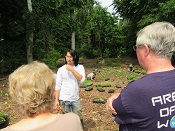
On June 9, 2018, Dyke Marsh members and friends learned about Potomac River wetland ecosystems and the interrelationships of plants, insects, birds and other biota, on a walk on the Preserve’s Haul Road trail led by Charles Smith, expert naturalist and Chief of Fairfax County’s Stormwater Planning Division, Watershed Projects Implementation Branch. He also discussed human intervention and how native Americans used some of the marsh plants.
News

On June 9, 2018, twenty volunteers and National Park Service staffers planted another 1,000 native plants on a cleared .65-acre site along the Haul Road trail. The site was previously overrun with non-native or invasive plants, like English ivy, mile-a-minute and stiltgrass.

The Friends of Dyke Marsh shared a table with the Friends of Huntley Meadows Park on June 16, 2018, at the annual Community Day in Gum Springs, a historically African-American community near the Dyke Marsh Wildlife Preserve.
FODMers Catherine Noonan and Mary Luceri greeted many festival-goers and helped youngsters make colorful birds. T-Rex and his “friend” dropped by and entertained all. The event drew 32 vendors and organizations, elected officials, a steel drum band and many guests.
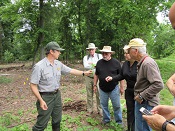
Keeping non-native, invasive plants out of the native plant restoration area along the Haul Road trail is a long-term challenge and efforts began on June 5, 2018, when ten volunteers participated in a training led by National Park Service (NPS) biologist Brent Steury. Brent stressed that the two priority plants to try to control are Japanese stiltgrass (Microstegium vimineum) and mile-a-minute (Polygonum perfoliatum). He urged volunteers to pull them out of the ground before they set seed. “If they set seed, we’ve lost,” he stressed.
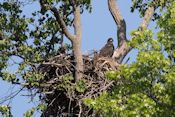
There were three active bald eagle (Haliaeetus leucocephalus) nests in the Dyke Marsh Wildlife Preserve this year, 2018. We will soon report the number of eaglets that successfully fledged. During the week of June 4, “our” eagles, this year’s birds, left the nest. Many visitors enjoyed observing them, especially those nesting near the Haul Road trail.

In the spring of 2018, the combination of heavy rains, easterly winds and normal tidal fluctuations due to the moon’s and sun’s gravitational effect created flooding tides in the wetlands of the Dyke Marsh Wildlife Preserve. Visitors saw mammals, birds, reptiles, insects and crustaceans foraging on or near the shores and tidal guts. Some altered some of their foraging patterns, moving to the trails or higher ground than they normally use. Observers saw abundant land snails climbing cattails and other marsh vegetation.